
Canada’s Energy Future: A Conversation with Minister Tim Hodgson
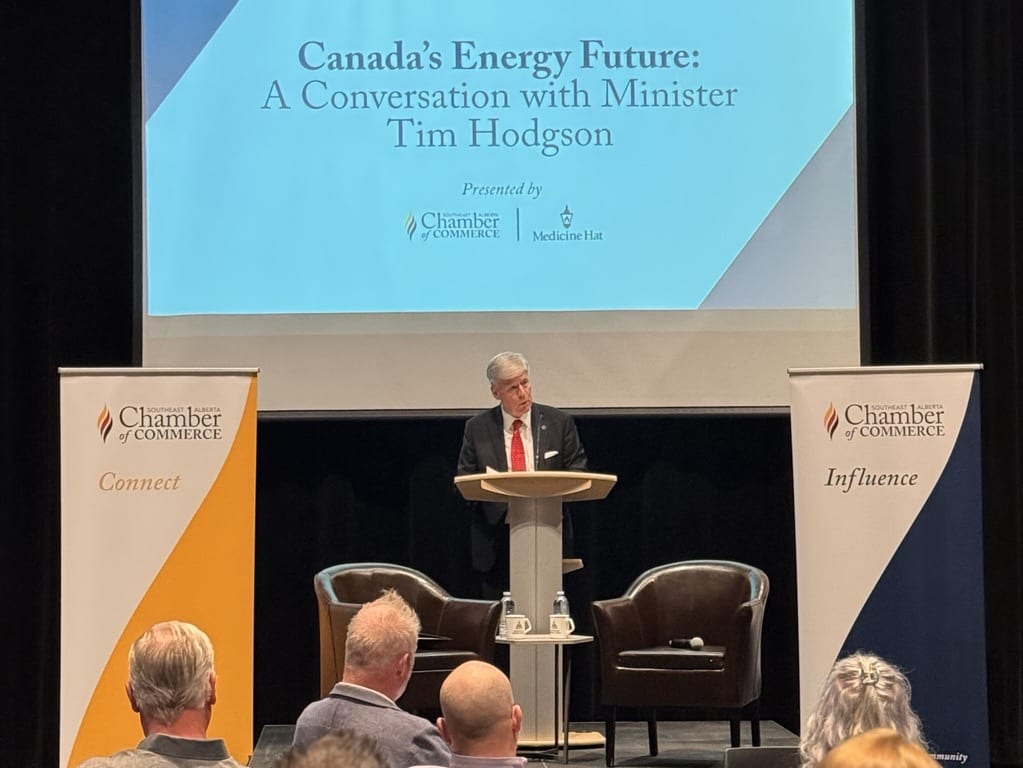
Canada’s Energy Future: A Conversation with Minister Tim Hodgson
When Tim Hodgson, Canada's Minister of Energy and Natural Resources, addressed the Southeast Alberta Chamber of Commerce in Medicine Hat on November 12, his message was clear: Canada is entering a period in which the decisions made today about energy, infrastructure, investment and productivity will shape our economic future for decades.
For Southeast Alberta, the message was particularly relevant. Minister Hodgson began with Medicine Hat's own history. The discovery of natural gas in the late 1800s provided an advantage, but it was the decisions that followed that transformed the community. Medicine Hat invested in infrastructure, maintained control of its energy resources, attracted industry and used affordable energy to build a manufacturing economy.
His central point was that having an advantage is not enough. Prosperity comes from what we choose to do with it. That is as relevant today as it was more than a century ago.
The Minister identified many of the factors businesses consider when deciding where to invest: tax competitiveness, regulatory certainty, infrastructure, skilled labour, affordable and reliable energy and confidence that the rules will remain predictable over the life of an investment.
These are also the factors that will determine whether Southeast Alberta can compete for the next generation of industrial development.
The region already possesses significant advantages. Minister Hodgson specifically highlighted Southeast Alberta's natural gas production, agriculture and agri-food processing, industrial manufacturing, energy services and emerging opportunities in electricity generation and energy-intensive industries. He also pointed to Medicine Hat's location along an important transportation corridor, its industrial and petrochemical base, abundant natural gas, renewable energy resources, agricultural strength and manufacturing expertise.
The opportunity now is to turn those advantages into projects and private-sector investment.
Budget 2026 signals a stronger focus on investment. A major theme of the Minister's remarks was Canada's effort to improve the investment environment. He highlighted the Productivity Mega Deduction in Budget 2026, which he said will allow businesses of all sizes to immediately deduct the full cost of most new investments. According to the speech, the measure is expected to reduce Canada's marginal effective tax rate on new business investment from 13 per cent to 6.4 per cent.
For Southeast Alberta, that could make investments in manufacturing equipment, agricultural machinery, energy technology and expanded production capacity more attractive.
The Minister also pointed to the Canada Growth Incentive, an enhanced Small Business Rollover provision and expansion of the Scientific Research and Experimental Development program as measures intended to encourage Canadian businesses to invest, commercialize technology and scale.
But tax incentives alone will not create regional investment. Businesses still need infrastructure, energy capacity, workforce, access to markets and regulatory certainty. That means Southeast Alberta needs to ensure it is positioned to take advantage of these national measures rather than simply watching investment occur elsewhere.
Perhaps the most significant message for our region was the Minister's emphasis on energy. He described affordable and reliable energy as the foundation of economic competitiveness and argued that growing global energy demand, manufacturing requirements and electricity demand from technologies such as artificial intelligence and data centres are creating significant opportunities for Canada and Alberta.
The federal government's National Electricity Strategy aims to double Canada's electricity grid to accommodate future demand, with Budget 2026 committing more than $50 billion toward the strategy.
That raises an important question for Southeast Alberta: How much of Canada's next generation of energy infrastructure and energy-intensive investment can be built here?
With natural gas, renewable generation potential, an established industrial base, available land, transportation connections and experience in energy development, Southeast Alberta should be positioning itself for opportunities ranging from industrial manufacturing and agri-food processing to electricity generation, data centres and other energy-intensive industries.
Another important theme was Canada's need to move beyond simply exporting resources. Minister Hodgson described a choice between continuing to ship commodities primarily to one market or developing, processing and adding value to those resources in Canada before selling into diversified global markets.
That principle strongly aligns with Southeast Alberta's economic opportunity and where national policy becomes regional economic development.
The Minister spoke about creating an "investment supercycle" where success in one sector generates opportunities in another. For Southeast Alberta, realizing that opportunity will require deliberate action.
The Southeast Alberta Chamber of Commerce believes governments and regional partners should focus on removing the practical barriers that determine whether investment actually occurs: timely infrastructure development, sufficient energy transmission capacity, efficient regulatory approvals, competitive taxation, transportation connectivity, workforce availability and predictable policy.
We must also ensure that national investment programs and major-project initiatives are accessible not only to Canada's largest metropolitan centres and companies, but to regions like Southeast Alberta where many of the country's natural resources, agricultural products, energy assets and industrial capabilities are located.
The goal should be straightforward: convert Canada's national economic priorities into regional projects, private investment, infrastructure upgrades, workforce opportunities and lasting business growth.
One of the most powerful elements of Minister Hodgson's speech was his comparison between Canada's present economic moment and Medicine Hat's history. More than a century ago, Southeast Alberta had access to an extraordinary resource. But natural gas itself did not build the economy. People invested in infrastructure, attracted industry and turned an energy advantage into a broader economic advantage.
Southeast Alberta has energy. We have agriculture. We have industrial land, manufacturing capability, entrepreneurs and strategic transportation connections.
The Chamber will continue working to advance this message with all levels of governments to ensure Southeast Alberta is not simply part of Canada's economic conversation, but part of the investment, infrastructure and projects that come from it.
Because if Canada is serious about moving from potential to production, Southeast Alberta should be one of the places where that transformation happens.
The Southeast Alberta Chamber of Commerce expressed their appreciate to Minister Hodgson for selecting Southeast Alberta for his timely visit and to the City of Medicine Hat for co-hosting the event with our Chamber.